

Previwas & Consulting
 language

Industry Trends
[Interview] How does China Chemical Second Construction Group manage knowledge in the "Top 100 Competitiveness of China's Construction Industry"?
Release time:
2022-12-05 15:26
Author:
China Chemical Engineering Second Construction Group Co., Ltd. (hereinafter referred to as "China Chemical Second Construction") is a wholly-owned subsidiary of China National Chemical Engineering Group Co., Ltd., which is managed by the State-owned Assets Supervision and Administration Commission of the State Council. The company was established in 1953 and is a large backbone enterprise in national petroleum and chemical engineering construction, with an annual construction production capacity of 20 billion yuan. The company has received multiple honors, including being one of the top 100 competitive enterprises in the construction industry and one of the top 100 enterprises in Shanxi Province.
Over the course of more than 60 years of development, China Chemical Second Construction has accumulated a wealth of knowledge achievements and project experience. How to better store and utilize these knowledge assets to support the innovative development of the business has been a topic of continuous reflection for China Chemical Second Construction. In 2021, China Chemical Second Construction partnered with Lanling to create a brand new knowledge management system. We are fortunate to invite Wang Xiaozhong, the relevant person in charge of the knowledge management department of China Chemical Second Construction, to share relevant project construction experience and insights in the field of knowledge management.
How to turn "intellectual property" into "assets" after more than 60 years of development
Q1: How do you view the importance of knowledge management for enterprises?
A: We often say that we are now in the era of knowledge economy, where knowledge is a valuable intangible asset for enterprises. Professor Chen Chunhua also proposed that "knowledge itself is productivity." Construction engineering enterprises are technology and knowledge-intensive enterprises, making effective knowledge management even more crucial. The role of knowledge management can be briefly summarized in eight words:
First is "energy storage," through knowledge management, organizational memory can be strengthened, allowing experience to be better inherited;
Second is "energy utilization," enabling enterprises to have a comprehensive understanding of their affairs and avoid repeating mistakes;
Third is "energy enhancement," allowing new employees and frontline staff to quickly master job knowledge;
Fourth is "energy creation," aggregating collective wisdom to solve problems and create value.
Q2: Why did your company undertake the construction of the knowledge management project? What challenges did you face?
A:Since its establishment in 1953, the company has developed for more than 60 years, accumulating a wealth of knowledge achievements, project experience, and classic cases. We hope to further enhance the utilization of these knowledge assets, improve our knowledge innovation capabilities, and thus enhance our core competitiveness in the market. The challenges we faced at that time mainly included:
Project materials are relatively scattered: The process materials of each project are scattered among different project members, lacking a systematic approach, which may lead to the loss of materials;
Project results cannot be archived in a timely manner: Project materials and technical achievements cannot be stored online, affecting reuse efficiency;
Learning efficiency needs to be improved: There is a lack of mobile learning platforms, and employees hope to engage in online learning, mobile learning, and fragmented learning;
Data sharing is difficult: The process materials of each project and the company's knowledge achievements cannot be interconnected in a timely manner, which is not conducive to the unified management of overall knowledge.
In light of the above challenges, we decided to initiate the construction of the knowledge management project, aiming to create a brand new knowledge management system to support the full-cycle management of knowledge accumulation, sharing, learning, application, and innovation.
Leveraging knowledge management to empower project operations and employee growth
Q3: Why did you choose to collaborate with Lanling? What were the main factors?
A:We evaluated several mainstream knowledge management vendors and ultimately chose to partner with Lanling for the project construction, mainly based on the following reasons:
● Over 20 years of professional accumulation: Lanling has over 20 years of experience in the field of knowledge management, is a participant in the formulation of national standards for knowledge management, and has successfully collaborated with many Fortune 500 and top industry enterprises;
● Professional knowledge management platform: They have a professional platform KMS, which has been market-tested and possesses multiple advantages such as advancement, reliability, scalability, ease of maintenance, security, and standardization;
●Mature consulting service system: Combining various domestic knowledge management methodologies, Lanling can provide complete consulting services for enterprises.
Considering all factors, we believe that Lanling has the capability to serve the multi-level knowledge management system centered on company control for China Chemical Second Construction Group, secondary units, and projects, which is why we chose to partner with Lanling. The project collaboration has also proven that our choice was correct.
Q4: What main scenarios and functions does this project construction include? What value do the different scenarios and functions bring to your company?
A:By establishing a brand new knowledge management system, the company can better accumulate and solidify knowledge assets, avoid knowledge loss, promote knowledge sharing, learning, utilization, and innovation, effectively reduce organizational operating costs, and enhance the core competitiveness of the enterprise. Specifically, it includes the following functions and values:
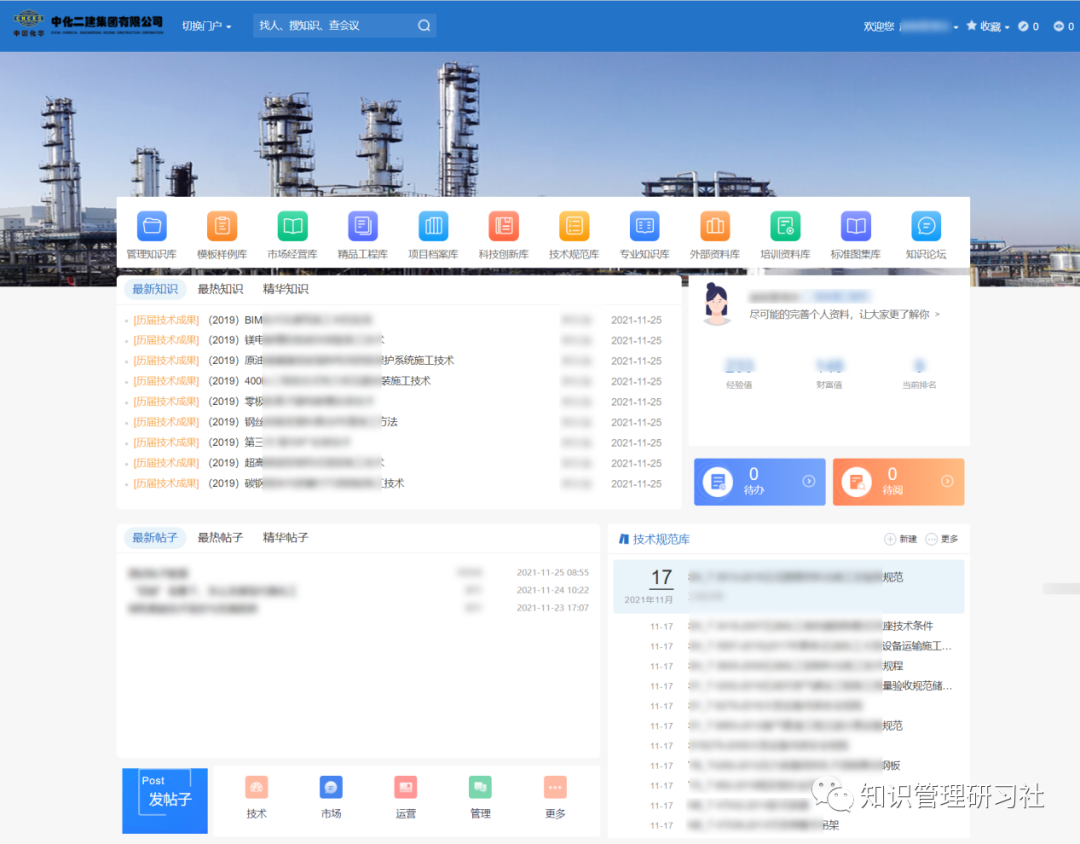
▲ Knowledge Portal
First, in terms of knowledge sources,for the four major modules of construction methods, technical processes, technological innovation processes, and intellectual property, we have realized the function of "pushing processes to the knowledge base," meaning that after project personnel submit processes and they are approved, the system automatically pushes the documents to the knowledge warehouse and project archive for knowledge storage.
Second, in terms of knowledge accumulation,we have built a knowledge warehouse, project archive, standard atlas, knowledge album, and project data library to solidify existing knowledge, making it convenient for everyone to learn at any time.
Knowledge Warehouse: Based on business types, we have formed a template sample library, excellent project library, technology innovation library, and other 10 major knowledge bases. Each knowledge base corresponds to the organizational structure, and we have sorted out the classification of knowledge bases; clarified reading, uploading, editing, and downloading permissions, knowledge attributes, and document approval processes to ensure the security and controllability of knowledge assets. As of now, various departments have uploaded a total of over 10,000 knowledge documents.
Project Archive: Mainly stores project topics, construction methods, intellectual property, papers, construction organization designs, construction plans, technical disclosures, engineering technology management summaries, and other project process assets.
Standard AtlasEstablish a standard atlas module to automatically fetch atlases from external websites to the system, allowing employees to consult and preview online at any time, saving a lot of time as they no longer need to search for atlases on external networks. So far, about 40,000 knowledge documents have been collected from external websites.
Knowledge AlbumCapture typical documents from the knowledge repository to form typical cases, displayed in the knowledge portal "Knowledge Album" section for employee learning.
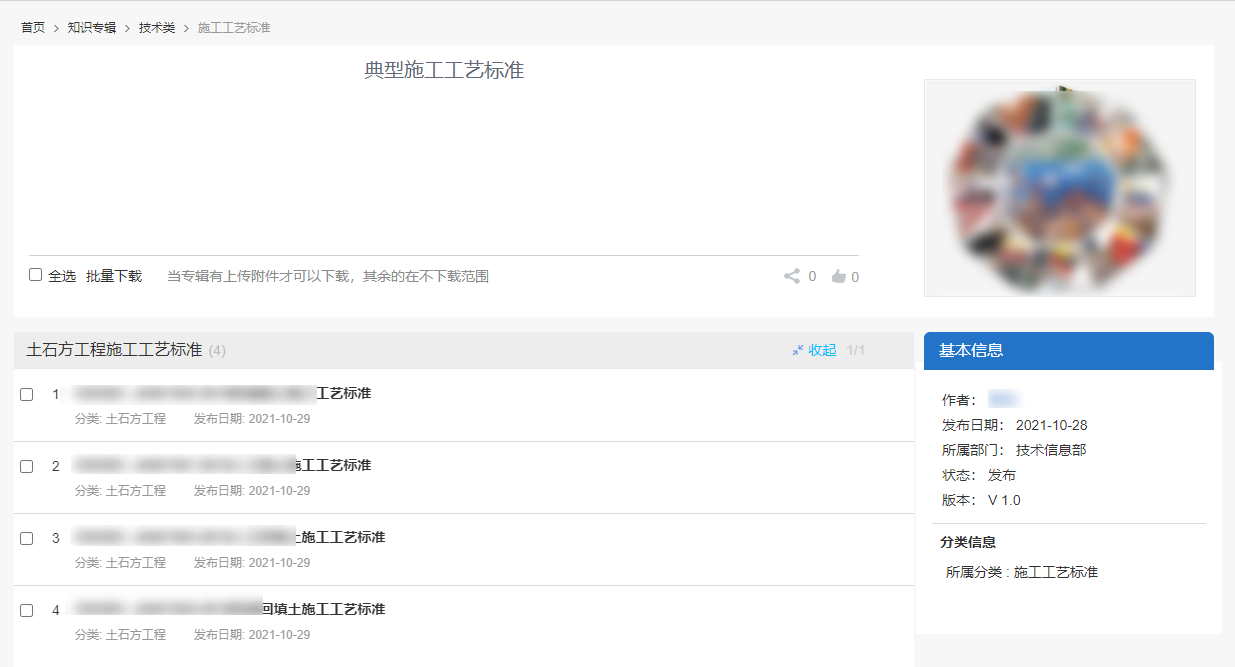
▲ Knowledge Album
Project Document LibraryA cloud drive for project personnel to store project documents, preventing file loss.
Thirdly, in terms of knowledge sharing and communication,a knowledge search, expert management, Q&A, and knowledge forum module have been built, allowing employees to quickly search for knowledge, find experts, ask questions, and share ideas, forming a unified platform for knowledge sharing and communication, enhancing work efficiency and strengthening corporate cohesion.
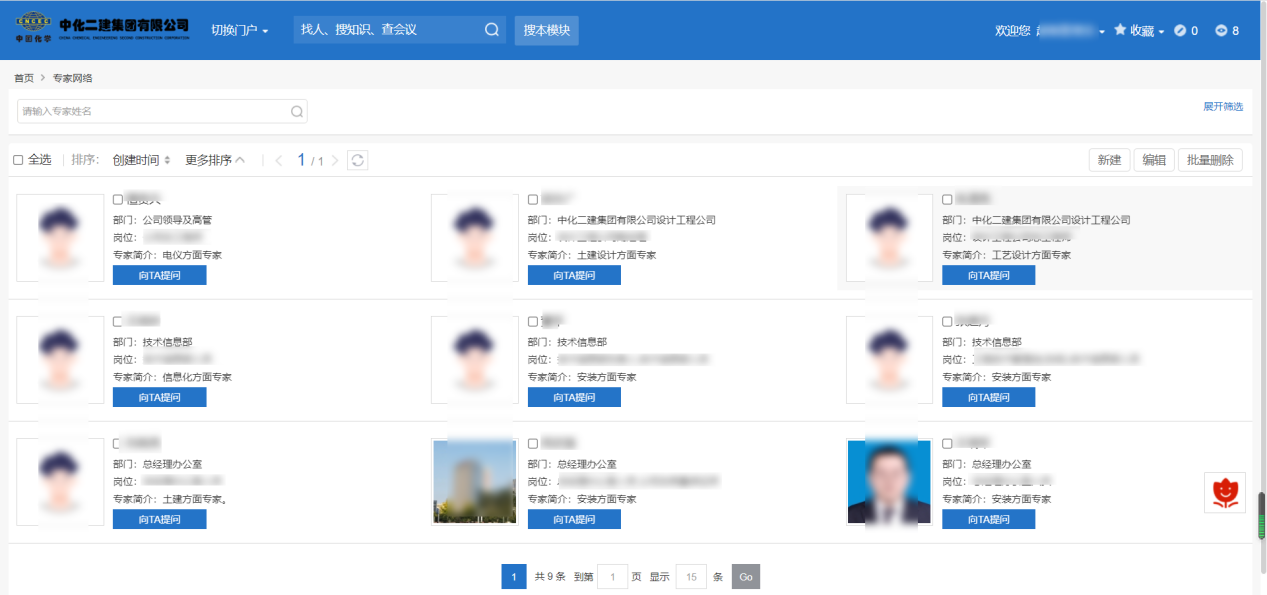
▲ Expert Network
Fourthly, in terms of knowledge achievements,knowledge statistics and points management applications have been constructed to help us effectively analyze the platform's operation, knowledge asset status, expert database, and personnel learning situation.
Q5: Overall, what changes and achievements has your company's knowledge management presented through this project?
A: 1. Improved organizational capability through information management.Construct a unified platform for knowledge, Q&A, knowledge albums, and knowledge forums, enabling employees to upload knowledge, ask questions online, post messages, and view albums, thus enhancing organizational capability.
2. Establish an online knowledge learning system for thousands of people:The system fully supports the entire group's online knowledge learning system, including 16 functional management departments, 22 secondary units, and over 200 projects, promoting internal knowledge sharing and data connectivity, conducive to unified knowledge management; building 10 major knowledge bases and standard atlas libraries for employees to learn knowledge at any time.
3. Improve learning efficiency and empower employee growth:Integrate mobile and corporate WeChat to achieve online learning, mobile learning, and fragmented learning, reducing learning costs and fully empowering employees to learn and grow.
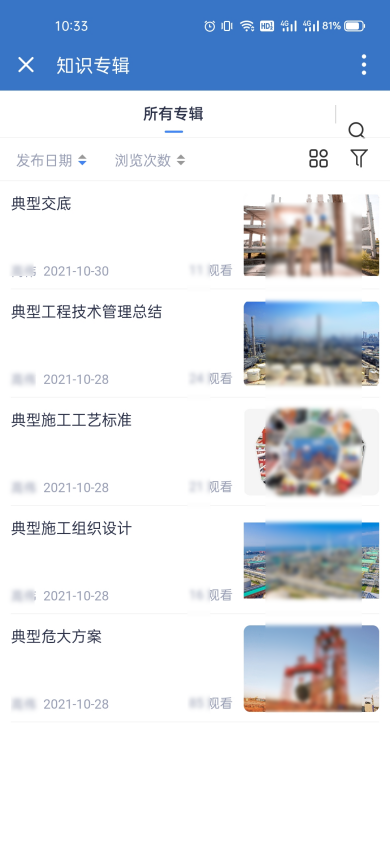
▲ Mobile Learning Interface
4. Effective management of the "Project Archive Library"Build a project archive library to store project process assets, standardizing, normalizing, scientific, and systematic project management, thereby regulating project implementation behavior and improving work quality.
Further promote knowledge management and build a learning organization.
Q6: In the future, what new deployments will your company's knowledge management work have, and what are the key work directions?
A:Since the knowledge management system went live, multiple functional departments, secondary units, and project personnel in the company have genuinely felt the convenience and value brought by knowledge management. In the future, we will promote knowledge management to more departments, secondary units, and related projects, striving to build a learning-oriented and knowledge-based enterprise. From the application of knowledge management, we will also focus on more applications such as knowledge maps and knowledge graphs, gradually upgrading the knowledge management system to better empower our enterprise and employees.
Related News
The 6th "Searching for Digital Intelligence Benchmarks" Selection
AIGC empowers various industries, and digital transformation drives organizations forward. In recent years, the Chinese government has elevated the digital economy to an important position in national strategy. With the support and guidance of national policies, various industries are actively seeking innovation and change in the wave of digital development.
Blue Ling Intelligent Organization Efficiency Course
AIGC has brought about a new wave of knowledge explosion, and the demand for knowledge in enterprises is becoming increasingly urgent. This also raises higher requirements for enterprise knowledge management. How to further utilize technologies and tools such as AIGC, LLM, RAG, and knowledge graphs to accelerate enterprise knowledge management and digital transformation, and achieve high-quality development, has become an important topic for many enterprises.
Blue Ling Knowledge Management Engineer Training
In the era of AIGC, technological innovation is surging. Under the wave of digitalization, the digitalization of knowledge management is increasingly valued by many enterprises. How to leverage knowledge management to better empower enterprises to "promote growth and increase efficiency" has become a topic of concern for many companies. At the same time, the challenge of cultivating knowledge management talent is continuously affecting the implementation of knowledge management in enterprises, slowing down the progress of building knowledge competitiveness and empowering business development. To accelerate the cultivation of knowledge management talent, Lanling has been holding training for knowledge management engineers since 2011, which has received high recognition from over 10,000 corporate trainees from companies such as Huawei, SF Express, Yili, Commercial Aircraft Corporation of China, Juewei, GAC Group, and Yuexiu.
China Knowledge Management Health Index Activity
In the era of the knowledge economy, knowledge itself is a productive force, and knowledge management has been increasingly valued by leading enterprises. To fully understand the application level of knowledge management in domestic enterprises and institutions, Tsinghua University's Technology Innovation Research Center, the Hong Kong Polytechnic University's Behavioral and Knowledge Engineering Research Center, the China National Institute of Standardization, the CIO Association of the China Software Industry Association, the Digital Industry Innovation Research Center, Jin Nang Expert, and Shenzhen Blue Ling Software Co., Ltd. have jointly initiated the "China Knowledge Management Health Index Research" activity. Through the conduct and results release of this research activity, it aims to further promote and deepen the application of knowledge management in the country.
The MAKE (Most Admired Knowledge Enterprise) Award, known as the "Oscar" of knowledge management, has been introduced to China since 2011. Outstanding companies such as PICC, China Merchants Bank, Qingdao Beer, Huaxia Fund, Shanghai General Motors, New Oriental, and Jianfa Real Estate have received this honor. To share the exemplary achievements of these benchmark companies and promote the development of knowledge management in China, we are launching a tour of case studies of MAKE award-winning enterprises for everyone.

The China MIKE Awards have so far unearthed nearly a hundred outstanding knowledge management and innovation management organizations, some of which have rushed out of the country and won the global MIKE Awards.


MIKE Consulting Registration

Join the Community & Business Collaboration
Guidance Unit
Global MIKE Study Group
Organizer
Research Center for Technological Innovation , Tsinghua University Shenzhen Landray Software Co., Ltd.
Support Unit
Behavior and knowledge engineering Research Center of Hong Kong Polytechnic University (BAKE Center)丨Cultural and Creative Center of Southern University of Science and Technology丨Computer Center, Harbin Institute of Technology, Shenzhen Branch丨School of Management Zhejiang University of Technology丨China National Institute of Standardization 丨 Shenzhen Federation of Commerce 丨 China Enterprise University Alliance 丨 Knowledge Management Forum 丨 Enterprise Management Magazine 丨 China Software Industry Association CIO Branch 丨 Digital Industry Innovation Research Center 丨 JNexpert 丨 Chief Digital Officer