

Previwas & Consulting
 language

Industry Trends
[MIKE Case] "Top 60 Design Enterprises in China" - China Communications Fourth Navigation Institute, Empowering Scientific Research and Innovation with Knowledge
Release time:
2022-12-05 15:37
Author:
Editor’s Note: As an authoritative and professional platform for knowledge innovation practice exchange, the Most Innovative Knowledge Organization (MIKE) Award has unearthed a large number of outstanding knowledge-based enterprises. As one of the co-organizers of China MIKE, Lanling has launched the "MIKE Award Case Tour" activity, which will share the knowledge management and innovation management practices of benchmark enterprises through interviews with famous companies and the writing of the "MIKE Award Special Edition."
China Communications Fourth Navigation Engineering Institute Co., Ltd. was established in 1964 and is a wholly-owned secondary subsidiary of China Communications Construction Company Limited, a national high-tech enterprise. Over the past fifty years, the institute has footprints in more than 120 countries and regions around the world. In 2019, the company ranked 27th among the top 60 design enterprises in China according to the authoritative ENR magazine.
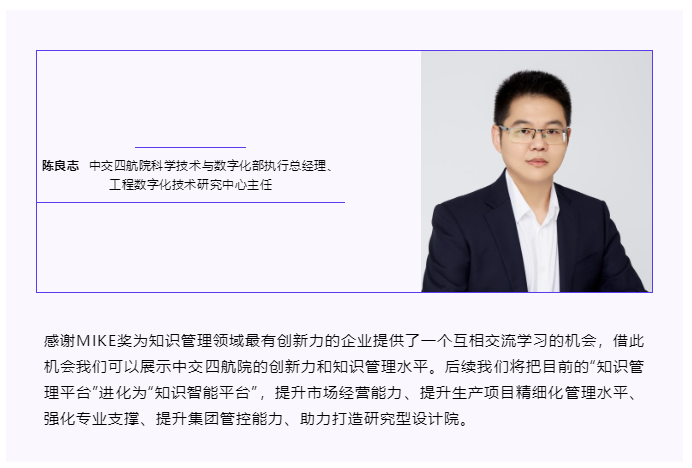
China Communications Fourth Navigation Institute has won the 2022 China MIKE Excellence Award for its multidimensional and systematic knowledge innovation achievements and will be recommended to compete for the global MIKE Award. In this issue of the "MIKE Award Case Tour" activity, we are honored to invite Chen Liangzhi, Executive General Manager of the Science and Technology and Digitalization Department and Director of the Engineering Digital Technology Research Center of the Fourth Navigation Institute, to share the successful experiences of the institute in knowledge management and innovation management.
Multiple measures to strengthen the cultivation of knowledge-based talents.
The Fourth Navigation Institute currently has more than 1,100 formal employees, including 2 national-level design masters, with over 90% holding a bachelor's degree or higher, making it a typical knowledge-intensive enterprise.
The Fourth Navigation Institute places great emphasis on the cultivation and empowerment of knowledge-based talents, establishing the concept that "talent is the first resource" and formulating talent management systems such as the "Double 123 Talent Project Management Measures" and the "Position and Level System Plan." With the cultural outline of "Happy Fourth Navigation Institute," guided by a culture of learning, and utilizing digital means, the institute has formed a talent view centered on value creators. At the same time, the institute strengthens talent resource management from various aspects such as recruitment, training, and promotion, ensuring talent reserves and stimulating the creative vitality of talents.
To continuously enhance employees' management, technical, and innovation capabilities, the Fourth Navigation Institute has formulated multiple training and management systems, including the "Employee Education and Training Management Measures" and the "Internal Trainer Management Measures," to promote knowledge sharing and dissemination, and to encourage knowledge creation. The company has also established various forms of knowledge sharing, including the Chief Engineer's "Lecture Hall," "Mentor-Mentee" programs, and micro-course competitions.
In addition, to cultivate a craftsman spirit, the Fourth Navigation Institute has established the Lu Yongchang (Guangdong Province Model Worker) Model Worker Studio and the Feng Yinghui (National Model Worker) Model Worker Studio, led by model workers with broad employee participation. These studios focus on the central tasks and key issues of the enterprise, leveraging the expertise and technical advantages of model workers to promote mutual growth and progress among employees. Chen Liangzhi introduced that many innovative cases and achievements have emerged from the model worker studios, including the Hong Kong-Zhuhai-Macao Bridge project and the Guangzhou Port Phase III project.
Building 12 major knowledge bases to drive business development with knowledge.
The Fourth Navigation Institute recognized the important role of knowledge management in technological innovation early on. In 2018, the institute began to focus on knowledge management, systematically sorting out existing digital information systems and the categories of existing knowledge assets, as well as their sharing, storage, and management models. Based on this, it built a knowledge management system that includes a regulation library, functional management library, training and certification library, production guidance library, lessons learned library, external knowledge library, scientific research excellence library, software learning library, standards and specifications library, market expansion library, project library, and expert library.
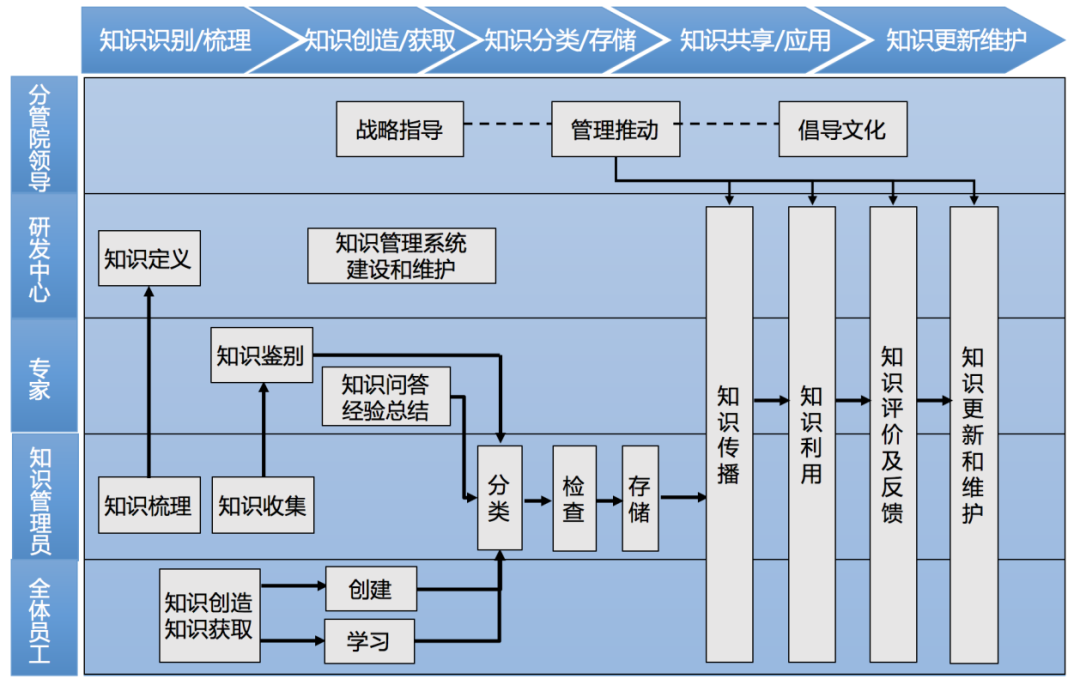
▲ Overall process of knowledge management at the Fourth Navigation Institute.
To further integrate knowledge with business, the Fourth Navigation Institute has sorted out a knowledge classification framework according to its knowledge management plan. It directly pushes project results, functional management systems, etc., from the comprehensive information system to the project library in the knowledge management system through interfaces. At the same time, it has designed templates for "Problem Record," "Technical Difficulty Record," and "XX Project (XX Phase) Case Summary" in the project management business process of the comprehensive information management system, embedding these templates into the project management process.
"When a project reaches a certain stage, these templates must be filled out, which ensures that tacit knowledge can be extracted during the project production process. On the other hand, knowledge that was previously not available in the comprehensive information system, such as personal experiences, guiding materials, textbooks related to professional certificates, software learning, award materials, etc., is categorized to various departments, where knowledge managers collect and upload them to the knowledge management system according to the knowledge classification requirements of the Fourth Navigation Institute."
Chen Liangzhi introduced that in the future, the knowledge management system will connect the interfaces of various digital systems to form data sharing across platforms, striving to achieve unified knowledge management across multiple platforms during the "14th Five-Year Plan" period, evolving from "knowledge accumulation platform," "knowledge refinement platform," and "knowledge service platform" to a "knowledge intelligence platform," enhancing market operation capabilities, group control capabilities, and refined management levels, and assisting in building a research-oriented design institute.
Cultivating an innovative culture to promote scientific research and effectiveness.
The Fourth Navigation Institute has always adhered to the innovative concept of "Technology lays the foundation for strong enterprises, and innovation drives new development," placing innovation at the core of the company's overall development. The company has created a "1234 Technology Innovation System" unique to the Fourth Navigation Institute, which includes one vision (to achieve high-quality development of the company), two drivers (internal and external change management), three systems (system, organization, and R&D system), and four outcomes (mastering core technologies, leading major scientific and technological projects, supporting major engineering projects, and cultivating innovative teams and talents).
Around the "1234 Innovation System," the Fourth Navigation Institute has constructed an innovation incentive mechanism from three aspects: first, formulating multiple scientific and technological management systems and work guidelines for systematic management; second, proposing excellent research topics and formulating project excellence plans; third, gradually improving the innovation incentive mechanism to stimulate employees' enthusiasm for innovation from both incentive and assessment perspectives.
In addition, the Fourth Navigation Institute continuously enhances its innovation capabilities by establishing innovation platforms and research teams, forming a "Technology Center + Research Institute" innovation group, with annual research investments exceeding 100 million yuan. The technology center has set up 28 professional committees, and the research institute is divided into different fields, consisting of 14 research centers. In the past three years, the innovation group has led or participated in two national-level projects and multiple provincial and ministerial-level projects.
In terms of management innovation, the Fourth Navigation Institute has proposed a quality management model of "Four Modernizations in Parallel, Excellence with Heart," a business model led by strategy, and a commercial model aimed at building comprehensive integrated capabilities.
In the field of technological innovation, the Fourth Navigation Institute has formed a complete technical evaluation system. In the past three years, 9 scientific and technological achievements have passed technical appraisal, reaching international advanced levels or above. The institute has received 29 awards at or above the provincial and ministerial levels, including 1 national-level scientific and technological award; it has established the Engineering Digital Research Center, HIDAS Research Institute, and Smart Ecology Company to provide support for technological innovation and improvement using new generation information technology.
The Fourth Navigation Institute has always held a leading position in domestic technology in the field of port engineering, continuously conducting core technology research in marine engineering, surveying technology, and new infrastructure fields. It has completed and passed appraisal for 22 scientific and technological achievements, of which 6 have reached international leading levels and 13 have reached international advanced levels. It has independently developed the first domestic digital surveying and design integration system for port engineering (HIDAS), breaking through multiple "bottleneck" technologies and becoming a key technology leader in the industry. Chen Liangzhi introduced that by the end of 2021, the Fourth Navigation Institute had received a total of 1,037 various awards, including 79 at the national level and 410 at the provincial and ministerial levels.
【Wonderful Dialogue】
China MIKE Organizing Committee:What knowledge do you pay the most attention to in the entire knowledge management process?
Chen LiangzhiIn the field of design institutes, what we care most about is the experiences designed by many of our chief engineers and deputy chief engineers. Many problems we encounter are actually seen repeatedly in different projects. Therefore, we are most concerned about consolidating these experiences from different leaders into our knowledge management system. Only after consolidating these can we further improve the quality of our entire design, enhance our design results, and only on this basis can we carry out the next step of innovation work.
China MIKE Organizing Committee:Since 2018, the Fourth Aviation Institute has systematically promoted knowledge management work. Now that four years have passed, what do you think are the results compared to before, and where are the benefits?
Chen Liangzhi:From 2018 and 2019, when we first established the knowledge management system, it has been three to four years now, and the content included in our knowledge system has been continuously increasing. At the beginning, not many people were willing to browse our knowledge system, and the knowledge was quite limited. After several years of construction, after integrating the business system with the knowledge management system, the richness of knowledge in our knowledge base has been continuously improved. So compared to three or four years ago, we find that the overall queryability of knowledge has become more convenient, and the knowledge available has become richer. At the same time, we also have an expert Q&A database on the knowledge platform, where experts can be messaged online, making communication channels more convenient.
We can give two detailed examples. We have focused on building a "Production Guidance Library". In this library, there are modules related to development and calculation for production design, which employees from the production department can download and use, bringing them great convenience. Another is the training and certification library. Our company requires everyone to obtain the corresponding qualifications, and we also require employees who pass the exams to upload the useful materials they have collected to the certification library to help other employees. This area has also received high feedback on its practicality.
China MIKE Organizing Committee: Based on the cooperation along the BIM industry chain, this is also a relatively complex issue and a hot topic currently. How many projects do you currently have, or what proportion of projects can achieve such digital delivery?
Chen LiangzhiRegarding the upstream and downstream cooperation of BIM, the main projects we are currently doing digital interaction on are several types. The first is LNG chemical terminal projects, where the owners have clear requirements for digital delivery, so all our LNG terminal projects must achieve digital delivery. The second part mainly involves some regions, such as Shenzhen, where all projects have BIM requirements explicitly stated in the contracts, and we must do digital delivery. There is also a part where the owner does not require it, but based on our own exploration needs for BIM technology, we will also have basic requirements for relevant projects to do BIM digitalization. Overall, currently in the industry, about 20%-30% of projects at the construction drawing stage need to carry out digital BIM modeling and handover work.
Related News
The 6th "Searching for Digital Intelligence Benchmarks" Selection
AIGC empowers various industries, and digital transformation drives organizations forward. In recent years, the Chinese government has elevated the digital economy to an important position in national strategy. With the support and guidance of national policies, various industries are actively seeking innovation and change in the wave of digital development.
Blue Ling Intelligent Organization Efficiency Course
AIGC has brought about a new wave of knowledge explosion, and the demand for knowledge in enterprises is becoming increasingly urgent. This also raises higher requirements for enterprise knowledge management. How to further utilize technologies and tools such as AIGC, LLM, RAG, and knowledge graphs to accelerate enterprise knowledge management and digital transformation, and achieve high-quality development, has become an important topic for many enterprises.
Blue Ling Knowledge Management Engineer Training
In the era of AIGC, technological innovation is surging. Under the wave of digitalization, the digitalization of knowledge management is increasingly valued by many enterprises. How to leverage knowledge management to better empower enterprises to "promote growth and increase efficiency" has become a topic of concern for many companies. At the same time, the challenge of cultivating knowledge management talent is continuously affecting the implementation of knowledge management in enterprises, slowing down the progress of building knowledge competitiveness and empowering business development. To accelerate the cultivation of knowledge management talent, Lanling has been holding training for knowledge management engineers since 2011, which has received high recognition from over 10,000 corporate trainees from companies such as Huawei, SF Express, Yili, Commercial Aircraft Corporation of China, Juewei, GAC Group, and Yuexiu.
China Knowledge Management Health Index Activity
In the era of the knowledge economy, knowledge itself is a productive force, and knowledge management has been increasingly valued by leading enterprises. To fully understand the application level of knowledge management in domestic enterprises and institutions, Tsinghua University's Technology Innovation Research Center, the Hong Kong Polytechnic University's Behavioral and Knowledge Engineering Research Center, the China National Institute of Standardization, the CIO Association of the China Software Industry Association, the Digital Industry Innovation Research Center, Jin Nang Expert, and Shenzhen Blue Ling Software Co., Ltd. have jointly initiated the "China Knowledge Management Health Index Research" activity. Through the conduct and results release of this research activity, it aims to further promote and deepen the application of knowledge management in the country.
The MAKE (Most Admired Knowledge Enterprise) Award, known as the "Oscar" of knowledge management, has been introduced to China since 2011. Outstanding companies such as PICC, China Merchants Bank, Qingdao Beer, Huaxia Fund, Shanghai General Motors, New Oriental, and Jianfa Real Estate have received this honor. To share the exemplary achievements of these benchmark companies and promote the development of knowledge management in China, we are launching a tour of case studies of MAKE award-winning enterprises for everyone.

The China MIKE Awards have so far unearthed nearly a hundred outstanding knowledge management and innovation management organizations, some of which have rushed out of the country and won the global MIKE Awards.


MIKE Consulting Registration

Join the Community & Business Collaboration
Guidance Unit
Global MIKE Study Group
Organizer
Research Center for Technological Innovation , Tsinghua University Shenzhen Landray Software Co., Ltd.
Support Unit
Behavior and knowledge engineering Research Center of Hong Kong Polytechnic University (BAKE Center)丨Cultural and Creative Center of Southern University of Science and Technology丨Computer Center, Harbin Institute of Technology, Shenzhen Branch丨School of Management Zhejiang University of Technology丨China National Institute of Standardization 丨 Shenzhen Federation of Commerce 丨 China Enterprise University Alliance 丨 Knowledge Management Forum 丨 Enterprise Management Magazine 丨 China Software Industry Association CIO Branch 丨 Digital Industry Innovation Research Center 丨 JNexpert 丨 Chief Digital Officer